
What shipping options do you have if your cargo doesn’t fit inside a standard ocean container?
Say hello to the flat rack container – a unique ocean container used for shipping oddly shaped or out-of-gauge cargo. They come in three standard sizes of 20′, 40′, and 40′ HC. Their sides that can be folded to make a flat rack, and they can be used to ship goods including forestry products, beams, pipes, and machinery, which have different dimensions and weights.
Shipping your Cargo with a Flat Rack
Loading, stuffing, and securing your cargo to the flat rack is crucial to ensure cargo integrity and safety while shipping from origin to destination. Cargo that is loaded and stuffed incorrectly onto flat racks will be rejected by the steamship lines.
Stuffing and Loading the Flat Rack
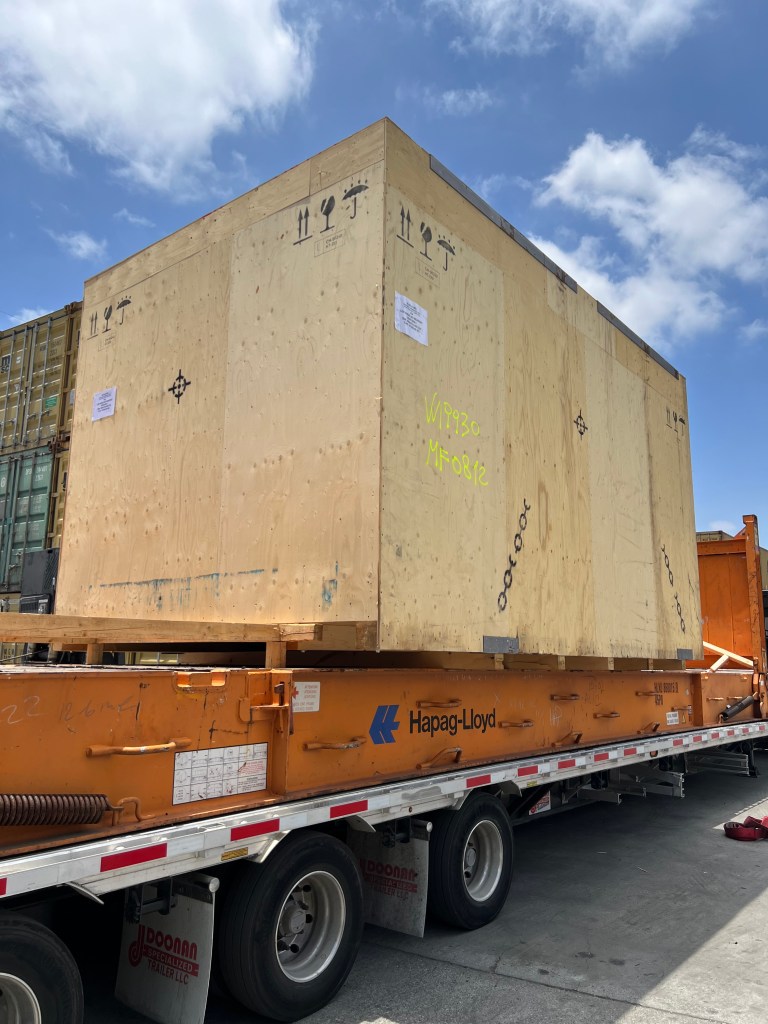
The first step in stuffing the flat rack is to know your cargo’s center of gravity. The center of gravity is what determines how stable your cargo is. The center of gravity is the point where all the weight of an object is evenly balanced. You need to indicate this with an international mark on every piece of cargo, especially on boxes and crates.
Lashing and Securing Cargo
Items used for securing cargo on flat racks include ropes, cables, wires, strapping, and nets. These items are anchored down to the sides of the flat rack via its lashing eyes and tensioned against the cargo to minimize unnecessary movement. The strength of a lashing system is given by different names like breaking strength (BS), lashing capacity (LC) or maximum securing load (MSL).
The International Maritime Organization recommends this general rule of thumb when it
comes to lashing/securing cargo for sea transport: The total MSL of the securing devices on each side of a unit of cargo (port as well as the starboard should be equal to the weight of the unit.

Anti-Slip Material
Wood dunnage or similar anti-slip materials (rubber) must be placed between cargo composed of metal and the flat rack bottom rails. Using high-friction anti-slip material reduces the number of lashings needed to secure the cargo to the flat rack.
Bedding
Your cargo must rest on the bottom two rails of the flat rack since they provide the most strength. Cross timbers can be used to transfer weight from the cargo to the rails. This is so that the wooden bedding of the flat rack avoids point pressure.
NCB Inspection
An NCB (National Cargo Bureau) inspection is a mandatory check for out-of-gauge cargo shipped on flat racks. It ensures the cargo is secured correctly and doesn’t pose a risk during transport. While inspections are typically conducted at or near the port, we can arrange for an NCB to be conducted at your location for an additional fee. The advantage here is quickly identifying any loading or securing issues that can be fixed at the point of origin, rather than at the port, where the cost can be 2 to 3 times higher.
How to Avoid Issues When Shipping OOG
Shipping OOG cargo comes with extra risk. A minor slip-up could trigger oversized consequences. Consider teaming up with a freight forwarder like us if you lack in-house expertise to evaluate and avoid the pitfalls that can lead to costly mistakes. Feel free to contact us for your next shipment.